
Elon Musk recently suggested that within the next 30–36 months, space could become the most economically compelling location for AI compute, driven by access to near-continuous solar energy, fewer terrestrial power constraints, and the ability to scale beyond the limits of Earth’s electrical grid.
While this may sound futuristic, the underlying trend is already taking shape.
SpaceX has publicly outlined plans to deploy orbital AI compute infrastructure as early as 2028, while several technology companies are exploring how space-based energy and computing could support the exponential growth of artificial intelligence.
At EverExcel, this is a theme we identified early.
Our investment strategy has focused on companies operating at the intersection of space, energy and advanced computing, including gaining early exposure to SpaceX and investing in the Series B round of Cowboy Space Corporation.
What attracted us to Cowboy Space Corporation is that the company is pursuing a vision that extends far beyond traditional aerospace.
Founded by Robinhood co-founder Baiju Bhatt, Cowboy is developing vertically integrated infrastructure for the emerging orbital economy, including space-based power generation, orbital data centers, communications infrastructure and launch systems.
We believe the most exciting opportunities in the space economy are increasingly moving beyond launch vehicles and satellites.
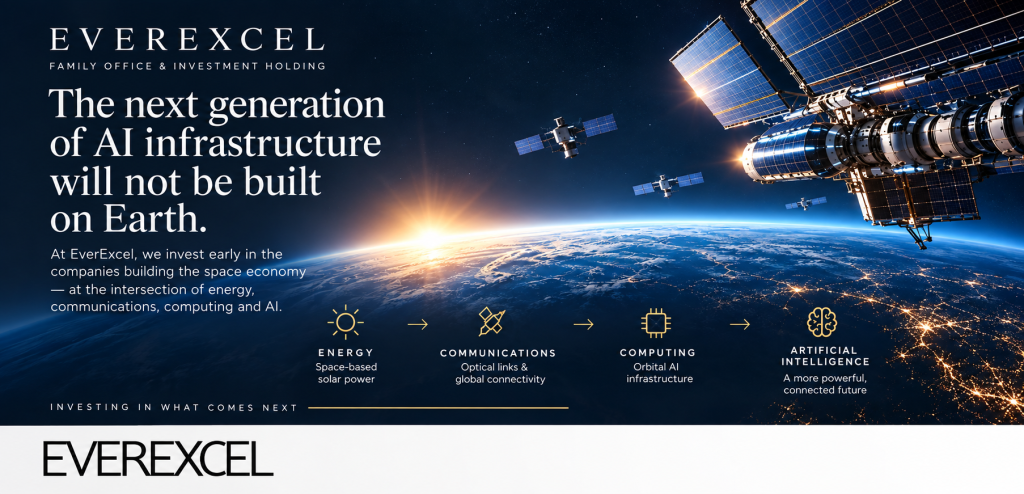
The next chapter may be defined by the infrastructure layer that enables large-scale activity in space:
Energy → Communications → Computing → Artificial Intelligence
Just as the internet created entirely new industries around data centers, cloud computing and digital infrastructure, we believe the convergence of AI and the space economy has the potential to create a new generation of global infrastructure companies.
At EverExcel, through our dedicated subsidiary SpaceExcel our objective is not simply to invest in the technologies of today, but to identify and support the platforms that may define tomorrow.
The space economy is evolving from exploration to infrastructure—and increasingly, from infrastructure to intelligence.